

On This Page
- How Long Does Probate Take?
- Why There Is No Single Probate Timeline
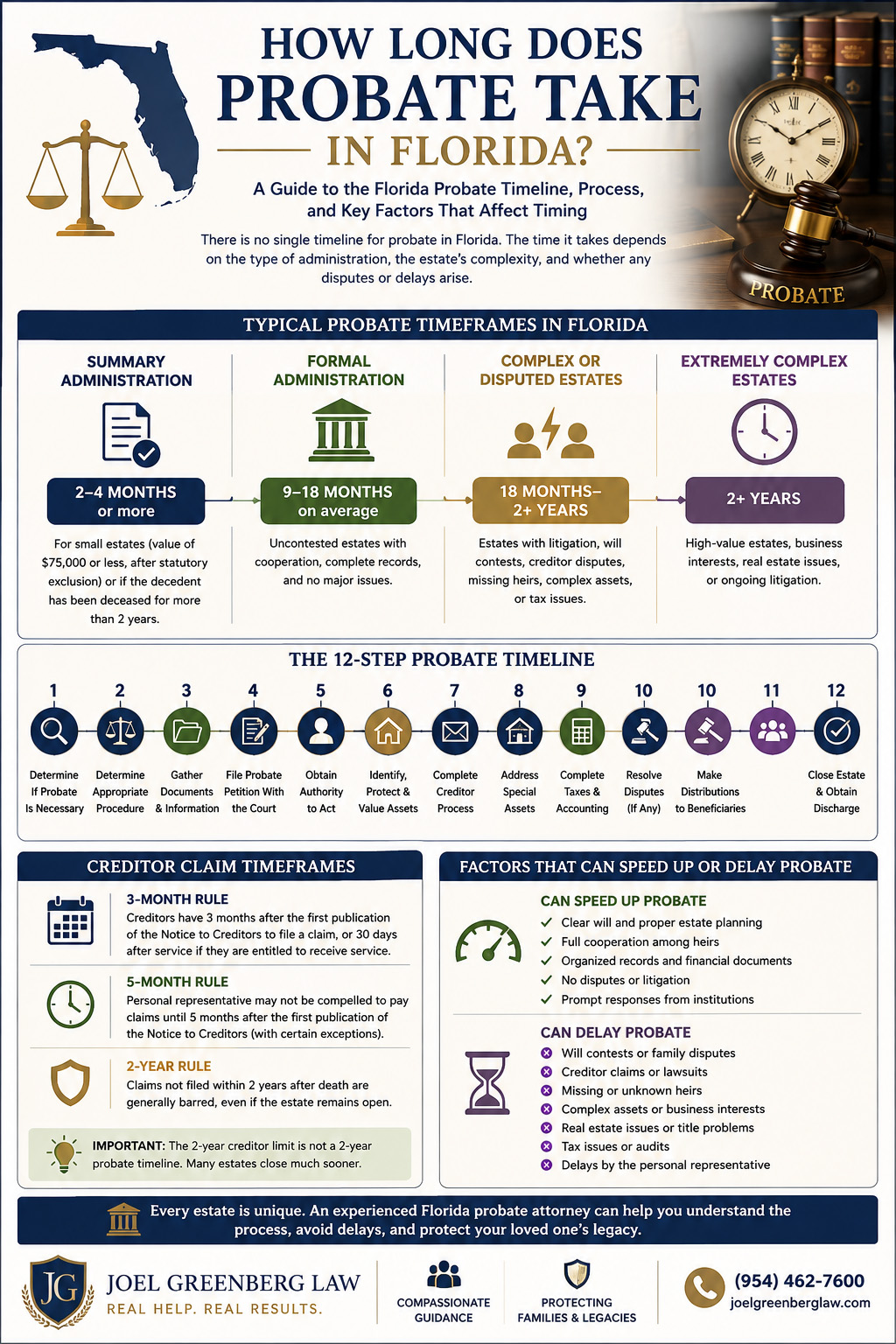
- Probate Timeline at a Glance
- How Long Does It Take to Open Probate?
- Formal Administration
- Why the Creditor Period Matters
- 3-Month vs. 5-Month vs. 2-Year Rules
- Florida’s Two-Year Creditor Rule
- Summary Administration
- How the Analysis Changes After Two Years
- Identifying and Valuing Assets
- Florida Homestead
- Selling Estate Real Estate
- Missing Heirs or Beneficiaries
- Creditor Disputes
- Will Contests
- Family Disputes
- Tax Issues
- Personal Representative Delays
- When Beneficiaries Receive Inheritance
- Partial Distributions
- What Makes Probate Move Faster?
- What Makes Probate Take Longer?
- Probate Timeline Table
- Step-by-Step Probate Timeline
- Common Timeline Mistakes
- How a Probate Lawyer Can Help
- Frequently Asked Questions
- Talk With a Florida Probate Lawyer
How Long Does Probate Take in Florida?
One of the first questions families ask after a death is:
“How long is probate going to take?”
There is no single Florida probate timeline that applies to every estate.
A relatively straightforward estate may move through probate in a matter of months, while an estate involving disputed creditor claims, difficult-to-sell real estate, Florida homestead issues, missing heirs, litigation, tax complications, business interests, or family disputes can take considerably longer.
The type of probate administration also matters.
A qualifying summary administration may involve fewer procedural steps than formal administration, but that does not create a guaranteed completion date.
Florida law also contains creditor deadlines and other procedural requirements that can prevent an estate from simply being opened, distributed, and closed immediately.
The better question is therefore:
“What steps must this particular estate complete before it can be safely and legally closed?”
How Long Does Probate Take in Florida?
Direct Answer: A Florida probate estate can take several months to more than a year depending on the type of administration, the assets involved, creditor issues, court processing, tax and accounting matters, family disputes, real estate, Florida homestead, litigation, and other complications.
A straightforward estate with known assets, cooperative beneficiaries, manageable creditor issues, and no litigation may move substantially faster than a contested or complex estate.
Formal administration generally involves more procedural steps than summary administration, but neither procedure has one guaranteed completion time.
Florida’s creditor rules also create important timing considerations. In formal administration, the personal representative generally publishes a Notice to Creditors. Many creditor claims are subject to a deadline measured from the first publication of that notice, while known or reasonably ascertainable creditors who must be served can have a deadline measured from service.
Florida Probate Has No Universal Completion Deadline
Probate tends to move faster when: assets are known, beneficiaries cooperate, creditor issues are manageable, property is straightforward, documents are complete, and no litigation exists.
Probate tends to take longer when: creditor claims are disputed, real estate must be sold, heirs cannot be located, homestead or title issues exist, litigation is pending, taxes are complicated, or business interests require administration.
Key Takeaway
Florida probate takes as long as necessary to complete the legal and practical work required by that particular estate.
The timeline depends on:
Procedure → Court Processing → Assets → Creditors → Homestead → Taxes → Disputes → Distribution → Closing
Why Is There No Single Florida Probate Timeline?
Probate is not one event.
It is a sequence of legal and administrative steps.
Depending on the estate, those steps may include:
- locating the will and estate documents;
- identifying the appropriate probate procedure;
- preparing and filing the initial petition;
- obtaining the court’s appointment of a personal representative when formal administration is used;
- obtaining Letters of Administration;
- identifying and protecting probate assets;
- providing required notices;
- publishing and serving Notice to Creditors when applicable;
- identifying and addressing creditor claims;
- determining Florida homestead status;
- valuing assets;
- managing or selling property;
- addressing tax and accounting matters;
- resolving disputes or litigation;
- paying appropriate expenses and obligations;
- making authorized distributions;
- preparing closing documents; and
- obtaining discharge or otherwise completing the administration.
Some of these steps can occur at the same time.
Others depend on earlier steps being completed.
Example
Consider two estates.
Estate A
The decedent leaves:
- a valid will;
- one bank account;
- a brokerage account;
- no Florida real estate;
- known beneficiaries;
- sufficient cash;
- no disputed creditor claims; and
- no family disagreements.
Estate B
The decedent leaves:
- disputed will documents;
- a Florida house requiring repairs and sale;
- a closely held business;
- several creditor claims;
- an heir whose location is unknown; and
- beneficiaries who disagree about administration.
It would make little sense to tell both families:
“Florida probate takes the same number of months.”
The work required by the two estates is fundamentally different.
Florida Probate Timeline at a Glance
A formal probate administration often moves through the following general sequence:
Death
↓
Locate Will and Estate Documents
↓
Identify Probate Assets
↓
Prepare and File Probate Petition
↓
Court Opens Estate
↓
Personal Representative Appointed
↓
Letters of Administration Issued
↓
Required Notices
↓
Notice to Creditors
↓
Asset Collection and Inventory
↓
Creditor Claim Period
↓
Homestead / Property / Tax / Accounting Issues
↓
Resolve Appropriate Claims and Disputes
↓
Pay Proper Expenses and Obligations
↓
Distribute Estate Property
↓
Prepare Closing Documents
↓
Discharge / Close Estate
Not every estate follows an identical path.
Summary administration uses a different procedural structure, and certain estates may involve additional steps.
Key Point
The probate timeline should be viewed as a sequence of required tasks, not as a countdown clock with one universal end date.
How Long Does It Take to Open Probate in Florida?
There is no single statutory number of days that guarantees when every Florida probate estate will be opened.
The initial timeline can depend on:
- how quickly the family locates the original will;
- whether the appropriate heirs and beneficiaries are known;
- whether necessary death certificates and other documents are available;
- how quickly the petition and supporting documents are prepared;
- whether the filing is complete;
- whether there are questions about who should serve as personal representative;
- whether waivers or consents are available;
- whether interested persons object;
- the particular court’s processing time; and
- whether the court requires additional information or corrections.
Can Probate Be Opened Immediately After Death?
Direct Answer: The probate process can begin relatively soon after death when the necessary information and documents are available, but filing a petition does not mean that the estate is instantly opened or that a personal representative immediately has authority to act.
The court must process the proceeding and, in formal administration, appoint the personal representative and issue the appropriate authority.
Why This Matters
Families sometimes believe:
“We filed probate yesterday, so the executor can sell everything today.”
That should not be assumed.
Florida uses the term personal representative, and legal authority depends on the applicable probate procedure and court action.
How Long Does Formal Administration Take in Florida?
Formal administration does not have one fixed completion period.
It generally involves more procedural steps than summary administration because a personal representative is appointed to administer the estate under court supervision.
The administration may involve:
- appointment of the personal representative;
- issuance of Letters of Administration;
- notice requirements;
- creditor procedures;
- inventory and valuation;
- management of estate property;
- Florida homestead issues;
- payment or resolution of claims;
- tax and accounting matters;
- distributions; and
- closing and discharge.
A straightforward formal administration may move efficiently when these matters are uncomplicated.
A complex formal administration may remain open substantially longer when issues cannot be resolved quickly.
What Can Make Formal Administration Take More Than a Year?
Potential causes include:
- disputed creditor claims;
- litigation;
- will contests;
- difficult real estate sales;
- business interests;
- missing beneficiaries or heirs;
- complicated tax matters;
- unresolved homestead or title issues;
- contested accountings;
- disputes concerning distributions;
- insufficient estate liquidity; and
- delays in obtaining information or completing required tasks.
Key Takeaway
Formal administration should not be measured only by the passage of time. It should be measured by whether the legal and administrative work necessary to close the estate has been completed.
Why Does the Florida Creditor Period Matter to the Probate Timeline?
Creditor procedures are one of the most important reasons a formal probate estate cannot always be distributed immediately.
Florida Statute §733.2121 generally requires a personal representative to promptly publish a Notice to Creditors unless creditor claims are otherwise barred by §733.710.
Florida Statute §733.702 then establishes important deadlines for presenting claims.
Many claims are barred unless filed on or before the later of:
three months after the first publication of the Notice to Creditors
or, for a creditor required to be served with a copy of the notice,
30 days after service on that creditor.
The statute contains exceptions and additional rules, so the creditor analysis should not be reduced to the statement:
“All creditors always have exactly three months.”
That is too broad.
Florida Legal Authority
Florida Statute §733.702 — Limitations on Presentation of Claims establishes important deadlines governing the presentation of claims against a Florida estate.
How Long Do Creditors Have to File Claims in Florida Probate?
Direct Answer: Many creditor claims are subject to the later of three months after first publication of the Notice to Creditors or, for a creditor required to be served with the notice, 30 days after service. Florida Statute §733.702 contains the governing rules, exceptions, and limitations.
Why This Matters
The personal representative needs to understand potential estate obligations before distributing property.
If all estate property is distributed too early and a valid claim must later be paid, the administration can become considerably more complicated.
Key Point
The creditor period is not simply administrative delay. It is part of the legal process for determining what obligations must be addressed before the estate can be safely completed.
Three-Month Creditor Period vs. Five-Month Payment Rule vs. Two-Year Limitation
Florida probate contains several creditor-related time periods that are easy to confuse.
They do not mean the same thing.
The Three-Month Creditor Claim Period
Florida Statute §733.702 generally provides that many claims must be filed by the later of:
- three months after the first publication of the Notice to Creditors; or
- for a creditor required to be served with a copy of the notice, 30 days after service on that creditor.
The statute contains exceptions and additional provisions.
This is primarily a claim-presentation deadline.
The Five-Month Payment Rule
Florida Statute §733.705 addresses payment of and objections to claims.
It provides, among other things, that a personal representative generally cannot be compelled to pay the decedent’s debts until after five months have expired from the first publication of the Notice to Creditors.
Florida Statute §733.705 also addresses when claims become due for payment. Subject to the statute, payment of claims is generally due at the end of five months from the first publication of the Notice to Creditors, with separate treatment for unmatured claims, contingent claims, and claims that are the subject of pending litigation.
This is different from the three-month claim-filing period.
Florida Legal Authority
Florida Statute §733.705 — Payment of and Objection to Claims addresses payment of claims, objections, and related timing requirements.
The Two-Year Limitation
Florida Statute §733.710 establishes a separate limitation.
Subject to the statute’s provisions and exceptions, two years after a person’s death, the estate, personal representative, and beneficiaries generally are no longer liable for a claim or cause of action against the decedent.
This two-year period runs from death, not from publication of the Notice to Creditors.
Florida Legal Authority
Florida Statute §733.710 — Limitations on Claims Against Estates establishes the separate two-year limitation and its statutory exceptions.
Why This Matters
These three concepts should not be collapsed into one “Florida creditor deadline.”
They answer different questions:
Three months / 30 days
→ When must many creditor claims be presented?
Five months
→ When can the personal representative generally be compelled to pay the decedent’s debts?
Two years after death
→ When does Florida’s separate limitation on claims become important?
Key Takeaway
Creditor timing in Florida probate is a system of different deadlines and protections—not one universal waiting period.
What Is Florida’s Two-Year Creditor Rule?
Florida Statute §733.710 is especially important when an estate is opened long after the decedent died.
Subject to the statute’s provisions and exceptions, two years after death, neither the decedent’s estate, the personal representative, nor the beneficiaries generally remain liable for claims or causes of action against the decedent.
The statute does not simply say:
“All probate ends after two years.”
Nor does it mean:
“You must wait two years before opening probate.”
Those are different concepts.
Example
Suppose one estate is opened three months after death.
Another estate is not addressed until more than two years after death.
The creditor analysis can be materially different because §733.710 measures its limitation from the date of death.
Why This Matters
The passage of two years can affect both creditor exposure and the potential availability of summary administration.
But the fact that two years have passed does not automatically resolve every probate issue.
Real estate title, homestead, heirs, beneficiaries, taxes, administration expenses, liens, and other legal matters may still require attention.
Key Point
The two-year creditor limitation is not a two-year probate timeline.
How Long Does Summary Administration Take in Florida?
Summary administration can potentially move more quickly than formal administration because it generally involves fewer administrative steps and does not use the same ongoing personal-representative structure as formal administration.
But Florida law does not promise that every summary administration will be completed within a specific number of days or weeks.
Timing can depend on:
- whether the estate actually qualifies;
- whether the petition is complete;
- whether all required information is available;
- whether beneficiaries and heirs are identified;
- creditor issues;
- Florida homestead;
- court processing;
- whether interested persons must receive notice;
- whether objections are filed; and
- whether additional documents or corrections are required.
Who Qualifies for Summary Administration?
Florida Statute §735.201 provides that summary administration may be available when the statutory requirements are satisfied and:
- the value of the entire estate subject to administration in Florida, less property exempt from creditor claims, does not exceed $75,000; or
- the decedent has been dead for more than two years.
In a testate estate, the statute also addresses whether the will directs administration as required by Chapter 733.
Florida Legal Authority
Florida Statute §735.201 — Summary Administration establishes the statutory circumstances under which summary administration may be available.
Is Summary Administration Always Faster Than Formal Administration?
Direct Answer: Not necessarily. Summary administration is designed as a more streamlined procedure, but the actual completion time still depends on the estate, the filings, creditor and homestead issues, interested persons, and court processing.
A complicated summary administration can encounter delays.
A well-organized formal administration can move efficiently.
Example
Estate A qualifies for summary administration but involves:
- disputed homestead;
- an heir who cannot be located; and
- disagreement over distribution.
Estate B requires formal administration but contains:
- known liquid assets;
- cooperative beneficiaries;
- no creditor disputes; and
- no real estate.
It would be unsafe to promise that Estate A will necessarily finish first merely because it uses summary administration.
Key Takeaway
Simplified procedure does not mean guaranteed completion date.
How Does the Probate Analysis Change After Two Years?
The passage of more than two years after death can change the probate analysis in two important ways.
First, §733.710 can significantly affect claims against the decedent and the estate.
Second, §735.201 provides that the passage of more than two years after death can be one basis for eligibility for summary administration, subject to the statute’s other requirements.
This does not mean families should intentionally wait two years to address an estate.
Waiting can create other problems, including:
- unresolved real estate title;
- unpaid property expenses;
- deteriorating property;
- inaccessible financial accounts;
- lost records;
- missing heirs;
- business-management problems; and
- delayed distributions.
Key Point
An older estate can present a different creditor and procedural analysis, but delay itself is not an estate-planning strategy.
The related Do I Need Probate in Florida? resource explains how summary administration and the two-year issue fit into the broader question of whether probate is necessary.
How Long Does It Take to Identify and Value Probate Assets?
There is no universal period for identifying and valuing estate property.
A simple estate may contain only a few readily identifiable assets.
A more complicated estate may require substantial investigation.
Assets can include:
- bank accounts;
- investment accounts;
- retirement benefits;
- real estate;
- vehicles;
- business interests;
- tangible personal property;
- insurance-related benefits;
- contractual rights;
- refunds;
- claims belonging to the estate; and
- other property interests.
Before assuming an asset belongs in probate, the personal representative and attorney may also need to determine whether it transfers through:
- a beneficiary designation;
- survivorship rights;
- trust ownership;
- payable-on-death arrangements;
- transfer-on-death arrangements; or
- another legal mechanism.
The related What Assets Go Through Probate in Florida? resource explains this classification process in greater detail.
What Can Delay Asset Identification?
Common problems include:
- incomplete financial records;
- missing account statements;
- unknown passwords or digital access issues;
- property located in another state;
- unclear ownership;
- old stock certificates;
- closely held business interests;
- valuable collections;
- disputed personal property;
- unclaimed property; and
- assets family members did not know existed.
Example
A daughter believes her father’s estate consists of:
- one checking account; and
- his Florida home.
After probate begins, she discovers:
- an old brokerage account;
- mineral rights in another state;
- an ownership interest in a small business; and
- valuable collectibles stored elsewhere.
The probate timeline may expand because the estate itself turned out to be more complicated than initially believed.
Key Takeaway
You cannot efficiently close an estate until you know what the estate owns.
Does Florida Homestead Make Probate Take Longer?
It can.
Florida homestead receives special constitutional and statutory treatment and should not automatically be treated like ordinary estate property.
Depending on the circumstances, the estate may need to address:
- whether the property qualified as the decedent’s protected homestead;
- who survived the decedent;
- whether there is a surviving spouse;
- whether there are descendants;
- whether minor children are involved;
- whether a devise was legally permitted;
- who is entitled to the property;
- creditor treatment;
- title issues; and
- whether the property will be retained or sold.
A court determination concerning homestead may also be important for title purposes.
Why This Matters
A probate estate containing only a bank account can present a very different timeline from an estate containing disputed Florida homestead.
The legal issue is not merely:
“How much is the house worth?”
It is:
“What legal rights exist in the property and what must be established before the estate can move forward?”
Key Point
Florida homestead can affect both the substance and timing of probate administration.
Does Selling a House Make Probate Take Longer?
It can.
Probate administration and the real estate market operate on different timelines.
Even when the legal administration is moving normally, estate real estate may need to be:
- secured;
- insured;
- cleaned;
- repaired;
- appraised;
- listed;
- marketed;
- placed under contract;
- inspected;
- financed by the buyer; and
- closed.
Title issues may also need to be resolved before a sale can occur.
Example
A personal representative is appointed promptly and the creditor process proceeds normally.
The estate’s principal asset, however, is a house requiring substantial repairs.
The beneficiaries agree to sell it.
Several months may pass while the property is repaired, marketed, contracted, and closed.
That time is part of the estate’s practical administration even though the probate court itself did not cause the real estate delay.
Why This Matters
Families sometimes attribute every month an estate remains open to:
“The probate court taking too long.”
That can be misleading.
The probate timeline can be affected by:
court processing
and
real-world asset administration.
They are not the same thing.
What Happens If an Heir or Beneficiary Cannot Be Located?
A missing heir or beneficiary can significantly complicate an estate.
The personal representative may need to make reasonable efforts to identify and locate interested persons and satisfy applicable notice requirements.
A missing person can affect:
- notice;
- hearings;
- waivers and consents;
- distribution;
- family-tree determinations;
- title issues; and
- closing.
Example
A decedent dies without a will.
Family members know that the decedent had a son from an earlier relationship but have had no contact with him for twenty years.
The family cannot simply remove him from the intestacy analysis because his location is unknown.
His potential legal rights must be addressed.
The related Probate Without a Will in Florida resource explains how Florida’s intestate succession rules determine which heirs may be entitled to probate property when there is no valid will.
Key Point
An heir does not lose potential inheritance rights merely because locating that person is inconvenient.
Can Creditor Claims Make Probate Take Longer?
Yes.
An uncomplicated creditor process is very different from an estate involving disputed or litigated claims.
A creditor may file a claim that the personal representative believes should not be paid.
An objection may then be filed.
Florida Statute §733.705 contains procedures and deadlines governing objections and actions concerning claims.
For example, the statute generally provides that the personal representative or another interested person may object to a claim by the later of four months after first publication of Notice to Creditors or 30 days after the timely filing or amendment of the claim, subject to the statute.
When an objection is served, additional deadlines can apply to the claimant.
Litigation concerning a creditor claim can substantially extend administration.
Florida Legal Authority
Florida Statute §733.705 — Payment of and Objection to Claims establishes procedures and timing rules concerning payment of, and objections to, creditor claims.
Does the Creditor Process End When the Claim-Filing Period Expires?
Direct Answer: Not necessarily. The end of the creditor filing period does not mean every creditor issue is finished. A timely filed claim may still require review, objection, negotiation, litigation, or payment before the estate can safely complete administration.
Why This Matters
The expiration of the initial creditor claim period does not necessarily mean:
“Every creditor issue is finished.”
A timely filed claim may still need to be:
- reviewed;
- accepted;
- objected to;
- negotiated;
- litigated; or
- paid according to its statutory priority.
Key Takeaway
The creditor claim deadline tells us when many claims must be presented. It does not guarantee that every timely claim will be resolved by that date.
Does a Will Contest Make Probate Take Longer?
It can—sometimes substantially.
A will contest or other probate litigation changes the estate from primarily an administrative proceeding into one that may also require contested court proceedings.
Potential disputes can involve:
- whether a will is valid;
- whether a later will exists;
- whether the decedent had testamentary capacity;
- whether undue influence occurred;
- whether the will was properly executed;
- whether a personal representative should serve;
- ownership of particular property; or
- interpretation of estate-planning documents.
These disputes may require:
- pleadings;
- discovery;
- document production;
- depositions;
- expert testimony;
- evidentiary hearings;
- mediation;
- settlement negotiations; or
- trial.
How Much Longer Does a Will Contest Make Probate?
Direct Answer: There is no reliable universal answer. A dispute resolved quickly by agreement may add relatively limited time, while contested probate litigation can extend administration substantially. The duration depends on the issues, evidence, parties, court schedule, discovery, settlement efforts, and whether appeals or related proceedings occur.
Why This Matters
The administrative portions of probate do not necessarily stop merely because a dispute exists.
Some estate work may continue while litigation is pending.
But final distribution or closing may have to wait until the contested issue is sufficiently resolved.
Key Point
A contested probate should not be given the same timeline estimate as an uncontested estate.
Can Family Disputes Delay Probate Even Without a Will Contest?
Yes.
Not every family disagreement becomes formal litigation.
Probate can slow when beneficiaries or heirs disagree about:
- who should serve as personal representative;
- whether property should be sold;
- the listing price for real estate;
- who should receive tangible personal property;
- whether a business should continue operating;
- the value of estate assets;
- expenses paid by the estate;
- creditor claims;
- proposed distributions;
- accountings; or
- the interpretation of estate documents.
Example
Three beneficiaries inherit a Florida house.
One wants to sell immediately.
One wants to rent the property.
The third wants to purchase the other beneficiaries’ interests but disagrees about the property’s value.
Even without a will contest, resolving those issues can affect how quickly the estate can administer and distribute the property.
Key Takeaway
Cooperative beneficiaries do not eliminate probate requirements, but unresolved beneficiary disputes can make those requirements harder and slower to complete.
Can Tax Issues Delay Florida Probate?
Yes.
Tax issues can affect the probate timeline depending on the estate.
Potential matters may include:
- the decedent’s final individual income tax return;
- fiduciary income tax returns for the estate;
- income earned during administration;
- tax reporting associated with asset sales;
- property-tax issues;
- basis and valuation questions;
- federal estate tax issues when applicable; and
- other tax obligations associated with estate administration.
Not every estate has complicated tax issues.
But when significant tax questions exist, the personal representative may need information from accountants, tax professionals, financial institutions, appraisers, or other advisers before final administration can be completed.
Why This Matters
Probate and tax administration can operate on overlapping timelines.
The court proceeding may be moving normally while the estate waits for information necessary to complete tax or accounting work.
Key Point
An estate should not be rushed to final distribution merely to meet an informal probate timeline if material tax obligations remain unresolved.
Can the Personal Representative Make Probate Take Longer?
Potentially.
The personal representative has significant responsibility for moving a formal administration forward.
Florida law treats the personal representative as a fiduciary and requires the estate to be settled and distributed as expeditiously and efficiently as is consistent with the best interests of the estate.
That does not mean the personal representative must rush.
It means the administration should proceed appropriately and efficiently.
Delays can arise when the personal representative:
- does not provide needed information;
- delays identifying assets;
- fails to maintain records;
- does not respond to the probate attorney;
- delays decisions concerning estate property;
- fails to address creditor matters;
- postpones necessary property maintenance;
- does not cooperate with tax or accounting professionals;
- delays proposed distributions; or
- fails to complete other required administration tasks.
Some delays, however, are outside the personal representative’s control.
Court processing, litigation, creditor disputes, real estate markets, missing heirs, tax matters, and third-party institutions can all affect the estate.
Florida Legal Authority
Florida Statute §733.602 — General Duties provides that a personal representative is a fiduciary who must settle and distribute the estate as expeditiously and efficiently as is consistent with the estate’s best interests.
Does Florida Require a Personal Representative to Move Probate Along?
Direct Answer: Yes. Florida law imposes fiduciary duties on the personal representative and requires the estate to be settled and distributed as expeditiously and efficiently as is consistent with the estate’s best interests.
Why This Matters
There is an important difference between:
necessary administration time
and
avoidable inactivity.
A complicated estate may legitimately take time.
An estate should not remain inactive simply because required tasks are not being completed.
When Do Beneficiaries Receive Their Inheritance in Florida Probate?
Beneficiaries do not necessarily receive their inheritance when probate begins.
The personal representative may first need to:
- identify and secure estate assets;
- determine creditor exposure;
- address proper claims;
- pay administration expenses;
- resolve tax issues;
- determine Florida homestead rights;
- sell or distribute property;
- maintain appropriate reserves;
- resolve disputes; and
- determine what can safely be distributed.
The timing also depends on the nature of the inheritance.
Cash may be easier to distribute than:
- real estate;
- business interests;
- valuable collections;
- disputed personal property; or
- assets requiring valuation or sale.
Example
An estate has $400,000 in cash but also faces:
- an unresolved creditor claim;
- estimated tax obligations; and
- ongoing expenses associated with estate real estate.
The existence of $400,000 in the estate account does not necessarily mean the entire amount can immediately be distributed to beneficiaries.
The personal representative may need to retain sufficient funds to address unresolved estate obligations.
Key Takeaway
Beneficiaries inherit an interest in the estate, but the timing of actual payment or delivery depends on proper administration.
Can Beneficiaries Receive Money Before Probate Closes?
Potentially.
Final closing of the estate and every beneficiary distribution do not necessarily have to occur at the same moment.
In an appropriate estate, the personal representative may be able to make a partial or interim distribution before final closing.
Whether that is appropriate depends on factors such as:
- available cash;
- known and potential creditor obligations;
- taxes;
- administration expenses;
- pending litigation;
- reserves;
- remaining assets;
- beneficiary disputes; and
- the personal representative’s fiduciary responsibilities.
Can I Get Part of My Inheritance Before Probate Is Finished?
Direct Answer: Possibly. Partial distributions may be appropriate in some estates when sufficient assets can safely be distributed while adequate property or reserves remain for unresolved obligations. They should not be assumed or made in a manner that jeopardizes the estate’s ability to complete administration.
Why This Matters
Beneficiaries sometimes assume there are only two choices:
Receive everything immediately
or
Receive nothing until the estate closes.
The actual administration may allow a more nuanced approach when circumstances permit.
What Makes Florida Probate Move Faster?
No one can eliminate statutory requirements or legitimate estate issues simply to make probate faster.
But efficient administration can reduce avoidable delay.
Complete Estate Documents
Locate the original will, trusts, amendments, deeds, beneficiary information, and financial records promptly.
Accurate Asset Information
Identify accounts, real estate, vehicles, business interests, insurance, and other property early.
Clear Family Information
Identify heirs, beneficiaries, addresses, and relevant family relationships.
Prompt Personal Representative Cooperation
Respond to requests for documents, decisions, signatures, and information.
Early Property Management
Secure, insure, maintain, and evaluate estate real estate and other significant assets.
Organized Creditor Review
Identify known or reasonably ascertainable creditors and address the required notice and claim procedures.
Early Tax and Accounting Coordination
Determine what returns, records, valuations, and accounting work may be necessary.
Beneficiary Communication
Clear communication can reduce misunderstandings about what is happening and why distributions may not occur immediately.
Early Identification of Disputes
Potential conflicts are easier to address when identified before they disrupt closing or distribution.
Key Point
The goal should not be the fastest probate possible. The goal should be an accurate, legally compliant probate with unnecessary delay minimized.
What Makes Florida Probate Take Longer?
Common causes of extended administration include:
- missing estate documents;
- unknown or difficult-to-locate assets;
- disputed ownership;
- missing heirs or beneficiaries;
- contested wills;
- family disputes;
- creditor litigation;
- insufficient liquidity;
- real estate requiring sale;
- property requiring substantial repairs;
- business interests;
- difficult valuations;
- Florida homestead disputes;
- title problems;
- tax complications;
- accounting disputes;
- litigation involving the estate;
- disagreements over distributions; and
- delays in completing required administration tasks.
Example
An estate may appear simple because it contains only three major assets:
- a Florida home;
- a business interest; and
- an investment account.
But each asset can create a separate timing issue.
The home may require sale.
The business may require valuation.
The investment account may be needed to provide liquidity for estate expenses.
The number of assets is small, but the administration can still be complex.
Key Takeaway
Probate complexity is determined by the problems that must be solved—not merely by the number or value of the assets.
Florida Probate Timeline Table
The following table provides a practical framework for understanding where time is spent during probate. It is not a promise that a particular stage will take a specific number of days or months.
| Probate Stage | What Happens | What Can Affect Timing |
|---|---|---|
| Initial review | Locate will, identify heirs, beneficiaries and preliminary assets | Missing documents, unclear family information |
| Opening estate | Prepare petition, file case, obtain appointment when required | Incomplete filings, objections, court processing |
| Asset identification | Locate, classify and value probate assets | Missing records, unusual assets, ownership disputes |
| Creditor process | Publish or serve notice, receive and evaluate claims | Late-served creditors, disputed claims, litigation |
| Homestead | Determine status and rights in protected homestead | Spouse or descendant issues, title disputes |
| Property administration | Secure, manage, repair, value or sell assets | Market conditions, repairs, financing, title |
| Personal representative administration | Make decisions, maintain records, provide information and coordinate administration tasks | Delayed information, incomplete tasks, fiduciary issues |
| Tax and accounting | Prepare returns, valuations and estate records | Complex assets, missing information, tax issues |
| Dispute resolution | Address beneficiary, creditor or will disputes | Discovery, mediation, hearings, litigation |
| Distribution | Pay or deliver property to beneficiaries | Reserves, claims, taxes, asset sales, disputes |
| Closing | Complete final administration and discharge | Unresolved claims, accounting or distribution issues |
Key Point
A delay at one stage can affect several later stages.
For example, a delayed real estate sale may affect:
- estate liquidity;
- taxes;
- creditor payments;
- beneficiary distributions; and
- final closing.
Step-by-Step Florida Probate Timeline
Step 1 — Determine Whether Probate Is Necessary
Identify which assets actually require probate administration.
The related Do I Need Probate in Florida? resource explains this threshold question.
Step 2 — Determine the Appropriate Probate Procedure
Evaluate whether the estate requires:
- formal administration;
- summary administration; or
- another legally authorized procedure.
Step 3 — Gather the Initial Documents and Family Information
Locate the will, death certificate, trust documents where relevant, deeds, financial information, and information concerning heirs and beneficiaries.
Step 4 — File the Appropriate Probate Proceeding
Prepare and file the required petition and supporting documents.
Step 5 — Obtain Authority to Administer the Estate
In formal administration, the court appoints the personal representative and the representative’s powers generally commence upon appointment.
Step 6 — Identify, Protect and Value Estate Assets
Determine what the probate estate owns and obtain appropriate date-of-death values.
Florida law requires a verified inventory in formal administration unless one has previously been filed.
Florida Legal Authority
Florida Statute §733.604 — Inventories and Accountings; Public Records Exemptions addresses the personal representative’s verified inventory and the identification and valuation of estate property.
Step 7 — Complete the Creditor Process
Publish and serve Notice to Creditors as required, evaluate claims, object when appropriate, and resolve valid estate obligations.
Step 8 — Address Homestead, Real Estate and Special Assets
Resolve legal and practical issues involving property that cannot simply be converted to cash or distributed immediately.
Step 9 — Complete Tax and Accounting Work
Prepare required tax filings and maintain the records necessary to account for estate administration.
Step 10 — Resolve Disputes
Address creditor disputes, beneficiary disagreements, will contests, ownership issues, or other litigation affecting administration.
Step 11 — Make Appropriate Distributions
Determine what property can safely be distributed and whether partial distributions are appropriate before final closing.
Step 12 — Complete Closing and Discharge
Once administration is complete, prepare the required closing documents and complete the process for discharge or other appropriate closure.
Final Decision Rule
The estate is ready to close when the work required for that estate is complete—not merely when an arbitrary number of months has passed.
Common Mistakes About How Long Florida Probate Takes
Mistake 1 — Expecting One Standard Probate Timeline
Different estates require different work.
Mistake 2 — Assuming Summary Administration Has a Guaranteed Completion Date
A streamlined procedure can still encounter creditor, homestead, heir, filing, or court-processing issues.
Mistake 3 — Confusing the Three-Month Creditor Period With the Entire Probate Timeline
The creditor claim period is only one part of administration.
Mistake 4 — Confusing the Five-Month Rule With the Claim-Filing Deadline
The five-month rule concerning when a personal representative generally can be compelled to pay decedent debts is different from the claim-presentation deadline.
Mistake 5 — Believing Probate Must Stay Open for Two Years
Section 733.710’s two-year limitation is not a mandatory two-year probate duration.
Mistake 6 — Assuming Probate Ends When the Creditor Period Ends
Assets, taxes, disputes, distributions, and closing requirements may remain.
Mistake 7 — Blaming Every Delay on the Probate Court
Real estate, creditors, financial institutions, beneficiaries, taxes, litigation, and administration work can all affect timing.
Mistake 8 — Distributing Everything as Soon as Cash Is Available
The estate may still need reserves for claims, expenses, taxes, litigation, or other obligations.
Mistake 9 — Waiting to Address Real Estate
Insurance, maintenance, repairs, title and market conditions can become significant sources of delay.
Mistake 10 — Ignoring a Small Problem Until Closing
An unresolved heir, creditor, asset, title, or accounting issue can become a major obstacle at the end of administration.
How Can a Florida Probate Lawyer Help Keep an Estate Moving?
A probate lawyer cannot eliminate statutory deadlines, court processing, legitimate creditor rights, real estate market conditions, or contested litigation.
A lawyer can, however, help organize the administration so required tasks are identified and addressed in the proper sequence.
That can include:
- determining the appropriate probate procedure;
- preparing complete probate filings;
- identifying required notices;
- helping classify probate assets;
- coordinating creditor procedures;
- addressing Florida homestead;
- assisting with real estate and title issues;
- identifying unresolved heir or beneficiary questions;
- helping the personal representative understand fiduciary duties;
- coordinating with accountants, appraisers, title professionals, or other advisers;
- addressing disputes before they prevent distribution or closing;
- evaluating whether partial distributions may be appropriate; and
- preparing the estate for final closing.
Can a Probate Lawyer Make Probate Faster?
Direct Answer: A probate lawyer cannot promise a particular completion date or remove legal requirements. Effective legal guidance can help reduce avoidable delay by identifying required tasks early, preparing appropriate filings, addressing problems as they arise, and helping the personal representative move the estate toward lawful distribution and closing.
Final Key Takeaway
The fastest probate is not necessarily the best probate.
The better objective is:
Complete the required work correctly → Resolve problems promptly → Protect estate assets → Address creditors and taxes → Make appropriate distributions → Close the estate without unnecessary delay.
Florida law reflects this balance by requiring the personal representative to settle and distribute the estate as expeditiously and efficiently as is consistent with the estate’s best interests.
Frequently Asked Questions About How Long Probate Takes in Florida
1. How long does probate take in Florida?
There is no single timeline for every Florida probate estate.
A relatively straightforward estate may take several months, while an estate involving creditor disputes, difficult real estate, Florida homestead, missing heirs, tax complications, litigation, business interests, or family disagreements can take more than a year.
The type of administration also matters. Formal administration generally involves more procedural steps than summary administration.
The better way to estimate the timeline is to identify the work that must be completed before that particular estate can safely and legally close.
2. What is the average probate timeline in Florida?
There is no statutory “average” probate timeline that applies to every Florida estate.
The duration depends on the procedure used, court processing, creditor requirements, estate assets, real estate, taxes, homestead, disputes, and the efficiency with which administration tasks are completed.
For that reason, an estimate based on the actual estate is more useful than relying on a statewide average.
3. What is the fastest probate can be completed in Florida?
Florida law does not establish one guaranteed minimum completion time for every probate estate.
A straightforward qualifying summary administration may involve fewer procedural steps than formal administration, but its timing still depends on complete filings, interested persons, creditors, homestead issues, and court processing.
Formal administration also includes creditor and other procedural requirements that must be addressed before the estate can be safely closed.
The objective should be to complete the required administration efficiently rather than promise an artificial minimum number of days.
4. How long does it take to open probate in Florida?
There is no single number of days that applies to every case.
The initial timeline can depend on how quickly the original will and other documents are located, whether the heirs and beneficiaries are known, whether the filing is complete, whether there is disagreement over who should serve as personal representative, and the court’s processing time.
In formal administration, filing the petition does not itself give someone authority to act as personal representative. The court must appoint the personal representative and issue the appropriate authority.
5. How long does formal administration take in Florida?
Formal administration does not have one fixed duration.
The estate may need to complete appointment, creditor procedures, asset identification, inventory and valuation, homestead analysis, property management, tax and accounting work, claim resolution, distributions, and closing.
A straightforward formal administration can move efficiently. A contested or complicated estate can take substantially longer.
6. How long does summary administration take in Florida?
Florida law does not guarantee that summary administration will be completed within a specific number of days or weeks.
Summary administration is a more streamlined procedure than formal administration, but timing can still depend on whether the estate qualifies, the completeness of the petition, creditor issues, Florida homestead, beneficiaries or heirs, objections, required notices, and court processing.
7. Is summary administration always faster than formal administration?
Not necessarily.
Summary administration generally involves fewer administrative steps, but the facts of the estate still control the practical timeline.
A summary administration involving disputed homestead, missing heirs, incomplete documents, or objections can encounter delays.
A well-organized formal administration involving known liquid assets and cooperative beneficiaries may move efficiently.
8. Why does Florida probate have a creditor period?
The creditor process helps determine what valid estate obligations must be addressed before the estate is fully distributed and closed.
The personal representative may need to publish and serve Notice to Creditors, identify known or reasonably ascertainable creditors, evaluate timely claims, object when appropriate, and provide for valid obligations.
This protects both the estate and the people entitled to receive estate property.
9. How long do creditors have to file claims in Florida probate?
Many creditor claims are generally subject to the later of:
- three months after the first publication of the Notice to Creditors; or
- for a creditor required to be served with a copy of the notice, 30 days after service.
Florida Statute §733.702 contains the governing rules, exceptions, and limitations.
The statement that “all creditors always have exactly three months” is therefore too broad.
10. What is the five-month rule in Florida probate?
Florida Statute §733.705 provides that a personal representative generally cannot be compelled to pay the decedent’s debts until after five months have expired from the first publication of the Notice to Creditors.
This is different from the deadline for presenting many creditor claims.
The five-month rule should therefore not be confused with the three-month creditor claim period.
11. What is the two-year creditor rule in Florida probate?
Florida Statute §733.710 establishes a separate limitation measured from the decedent’s death.
Subject to the statute’s provisions and exceptions, two years after death the estate, personal representative, and beneficiaries generally are no longer liable for a claim or cause of action against the decedent.
This does not mean probate must remain open for two years, nor does it mean families must wait two years before opening probate.
Section 733.710 also contains important exceptions, including certain claims timely filed under §733.702 within two years after death that remain unpaid or otherwise unresolved under §733.705, as well as specified mortgage, security-interest, and possessory-lien rights.
12. Does Florida homestead make probate take longer?
It can.
Florida homestead receives special constitutional and statutory treatment.
The estate may need to determine whether the property qualifies as protected homestead, who is entitled to it, whether a surviving spouse or descendants have rights, whether a devise was legally permitted, how creditors are affected, and whether a court determination is appropriate for title purposes.
Those issues can add time to administration.
13. Does selling a house make probate take longer?
It can.
Estate real estate may need to be secured, insured, cleaned, repaired, appraised, listed, marketed, placed under contract, inspected, financed, and closed.
Title issues may also need to be resolved.
The real estate market therefore can affect how long an estate remains open even when the probate court itself is processing matters normally.
14. What happens if an heir or beneficiary cannot be found?
A missing heir or beneficiary can delay probate.
The estate may need to make appropriate efforts to identify and locate the person and satisfy applicable notice requirements.
A missing interested person can affect notices, waivers, hearings, distributions, family-tree determinations, and closing.
A person’s potential legal rights are not eliminated merely because locating that person is difficult.
15. Does a will contest make probate take longer?
It can, sometimes substantially.
A will contest can involve discovery, document production, depositions, expert testimony, mediation, hearings, settlement negotiations, trial, or other contested proceedings.
Some estate administration may continue while the dispute is pending, but final distribution or closing may depend on resolving the contested issue.
16. Can creditor disputes delay probate?
Yes.
The expiration of the initial claim-presentation period does not necessarily resolve every creditor matter.
A timely claim may need to be reviewed, objected to, negotiated, litigated, or paid according to Florida law.
Florida Statute §733.705 also establishes timing for objections to claims and procedures that can apply after an objection is filed.
17. Can taxes delay probate?
Yes.
Depending on the estate, administration may involve the decedent’s final income tax return, fiduciary income tax returns, income earned during administration, property-related tax issues, valuations, basis questions, and federal estate tax matters when applicable.
Not every estate has complicated tax issues, but unresolved material tax obligations can affect final distribution and closing.
18. When do beneficiaries receive their inheritance?
Beneficiaries do not necessarily receive their inheritance when probate opens.
The estate may first need to identify assets, address creditor exposure, pay proper expenses and obligations, resolve tax matters, deal with Florida homestead, sell property, maintain appropriate reserves, and resolve disputes.
The timing also depends on whether the inheritance consists of cash or property requiring valuation, management, or sale.
19. Can beneficiaries receive money before probate closes?
Potentially.
A personal representative may be able to make a partial or interim distribution before final closing when doing so is appropriate and sufficient estate property or reserves remain to address unresolved obligations.
Whether a partial distribution is appropriate depends on creditor exposure, taxes, administration expenses, litigation, remaining assets, reserves, and the personal representative’s fiduciary responsibilities.
Beneficiaries should not assume either that everything must be withheld until closing or that available cash can automatically be distributed immediately.
20. What causes Florida probate to take more than a year?
Many factors can extend probate beyond a year.
Examples include:
- disputed creditor claims;
- will contests;
- family litigation;
- difficult real estate sales;
- business interests;
- missing heirs or beneficiaries;
- Florida homestead disputes;
- title problems;
- complicated taxes;
- contested accountings;
- insufficient liquidity;
- difficult asset valuations;
- ownership disputes; and
- delays in completing required administration tasks.
The fact that an estate has been open for more than a year does not by itself establish that something has gone wrong.
The better question is whether there are legitimate unresolved issues and whether the administration is moving forward appropriately.
Talk With a Florida Probate Lawyer About the Probate Timeline
Families often want a precise completion date at the beginning of probate.
In many estates, a more useful approach is to identify:
- which probate procedure applies;
- which assets must be administered;
- what creditor deadlines apply;
- whether Florida homestead is involved;
- whether real estate must be sold;
- whether heirs or beneficiaries are difficult to locate;
- whether disputes exist;
- what tax and accounting work is required;
- whether partial distributions may be appropriate; and
- what must still happen before the estate can close.
Joel Greenberg Law can help families and personal representatives identify the stages affecting a Florida probate estate and distinguish unavoidable administration time from delays that may be preventable.
The related Do I Need Probate in Florida? resource explains whether probate administration is necessary in the first place.
What Assets Go Through Probate in Florida? explains which property may require administration and which assets may transfer outside probate.
Probate Without a Will in Florida explains how Florida’s intestate succession rules apply when there is no valid will governing probate property.
The broader Probate Lawyer Broward County HUB explains formal administration, summary administration, personal representative responsibilities, creditors, Florida homestead, and other probate issues.
Final Key Takeaway
There is no single number of months that accurately describes every Florida probate estate.
A useful probate timeline asks:
What procedure applies?
What assets must be administered?
When did the creditor period begin?
Are any claims disputed?
Does real estate need to be sold?
Is Florida homestead involved?
Are all heirs and beneficiaries known and located?
Are taxes or accounting issues unresolved?
Is litigation pending?
Can partial distributions safely be made?
What remains before closing?
The goal is not simply to make probate move quickly.
The goal is to complete the administration accurately, efficiently, and without unnecessary delay.
FREE CONSULTATION


